Northwest Arkansas weather swings from saturated springs to bone-dry late summers. That moisture cycle plays havoc with fill compaction on Fayetteville job sites. The sand cone test gives us a direct measurement of in-place density right when it matters. No lab delay. No indirect correlation. Just a calibrated sand volume and a hole in the ground. In Fayetteville, where much of the subgrade sits on weathered Boone limestone residuum or shale-derived fill, verifying compaction layer by layer prevents differential settlement that shows up within two years of building. We run the test per ASTM D1556 while the compactor is still on-site. This keeps earthwork moving and avoids costly rework later.
A sand cone test delivers the one number that matters during earthwork: is the fill compacted to spec, right now, at this lift.
Scope of work in Fayetteville Arkansas
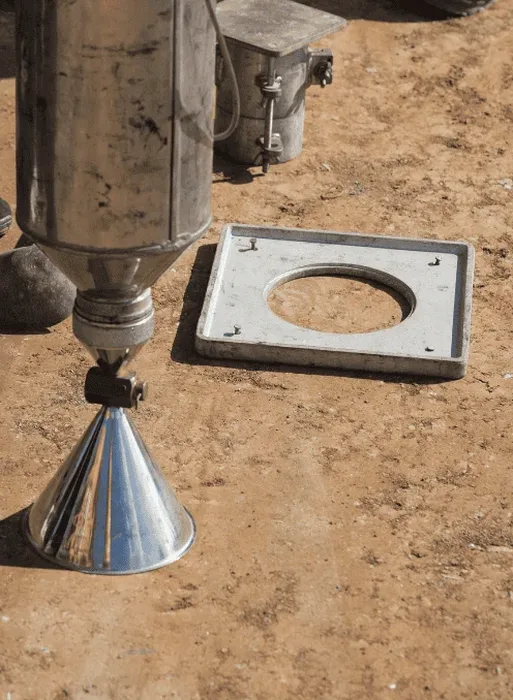
Critical ground factors in Fayetteville Arkansas
On Fayetteville sites we often see fill lifts placed thicker than the spec allows. A 12-inch loose lift that gets rolled looks fine on top. The bottom four inches never see compactive effort. The sand cone test catches this because we excavate through the full lift thickness. Another common issue is moisture conditioning. Shale fill from the Fayetteville Shale formation dries fast in August wind. If the crew waters it but doesn't let it soak in, the surface looks moist while the core stays dry. The test hole reveals moisture streaks and density gaps that a surface nuclear gauge would miss. Utility trenches are the worst offenders. Backfill around sewer laterals in Fayetteville's clay soils gets minimal compaction unless an inspector is standing there. A single density test in a trench backfill can prevent a pavement dip that appears after the first rainy season. The cost of the test is negligible next to the cost of cutting and patching asphalt.
Our services
We provide field density testing across Fayetteville and Washington County for earthwork, utility trenches, parking lots, and building pads. Each test includes the density calculation, moisture content, and a comparison to the specified Proctor target.
Fill compaction verification
Per-lift density testing during structural fill placement. We test each lift before the next one goes down, keeping the project on schedule.
Utility trench backfill testing
Density checks in pipe zones and roadway crossings. We test the bedding, haunch, and cover zones per city of Fayetteville or AHTD requirements.
Building pad proof-rolling support
Pre-pour density verification on prepared subgrade. We combine sand cone tests with visual observation of the proof roll to confirm uniform support.
Subgrade acceptance testing
QA/QC density tests for pavement subgrade. We document results for the geotechnical report and provide same-day notification if a lift fails.
Common questions
How much does a sand cone density test cost in Fayetteville?
How many tests do I need for a building pad?
The IBC and project specifications usually require one test per lift per 2,500 square feet of fill area, or one test per 500 cubic yards of fill placed. On a typical Fayetteville commercial pad we test every lift in at least four to six locations. The exact frequency gets confirmed with the geotechnical engineer of record before earthwork starts.
Can you test through gravel or rock fill with the sand cone?
The sand cone method works best in soils with a maximum particle size under 1.5 inches. For fills with larger rock or chert fragments common in Fayetteville quarries, we increase the test hole volume and use a larger sand cone apparatus. If the fill is predominantly rock, a water replacement method or a calibrated test fill with observation may be more appropriate.
What is the difference between a sand cone test and a nuclear gauge test?
The sand cone test measures density directly by volume displacement. It does not require calibration for the specific soil type and is unaffected by chert fragments, moisture variation, or chemical composition. A nuclear gauge is faster but must be calibrated against a sand cone baseline for each soil type and requires a radioactive materials license. In Fayetteville's residual clays with chert, we find the sand cone to be more reliable as the reference standard. More info.