IBC Chapter 18 and ASCE 7-22 require a site-specific liquefaction evaluation for any Seismic Design Category D project in Washington County. Fayetteville sits on interbedded alluvial deposits from the West Fork White River and its tributaries. That means loose saturated sands and silts are common across the valley floor. A standard bearing capacity check won't catch a thin liquefiable lens at 12 feet. We see it in the lab all the time. The SPT drilling data from our Fayetteville jobs routinely shows N-values below 10 in the upper 25 feet, especially east of College Avenue where the water table sits just 6 to 8 feet down. Combine that with a M7.0 New Madrid event or a local M5.5 on the Ozark Dome, and the cyclic stress ratio exceeds the cyclic resistance ratio fast. That's a costly problem waiting under the slab. We run the Youd-Idriss 2001 simplified procedure, corrected for fines content from grain size and Atterberg limits, to determine if the factor of safety drops below 1.1.
A single liquefiable sand lens at 15 feet depth can trigger differential settlement exceeding 4 inches during a design earthquake—enough to shear utility lines and crack grade beams.
Scope of work in Fayetteville Arkansas
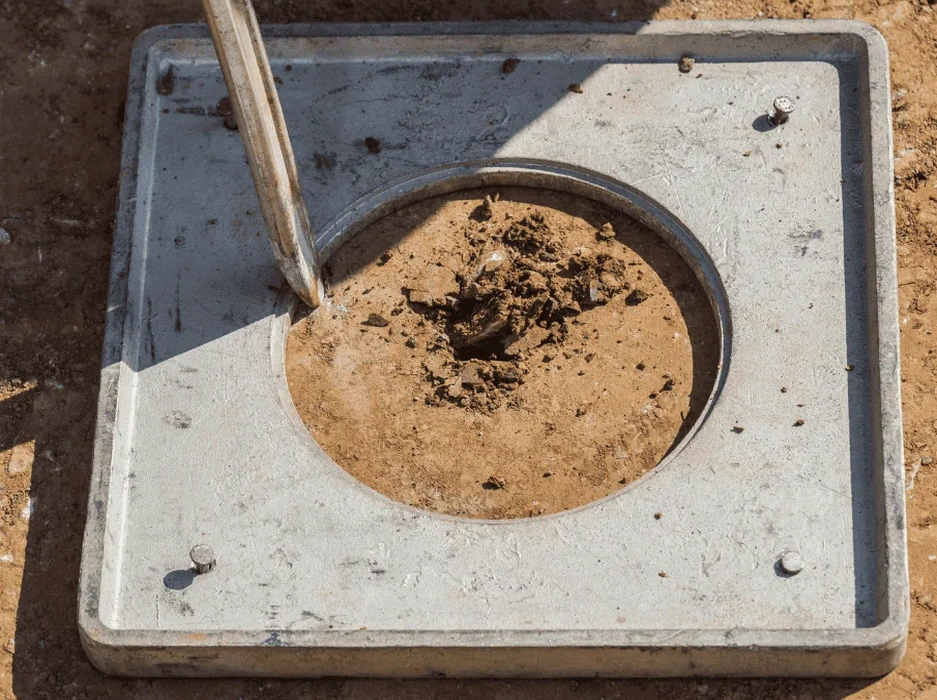
Critical ground factors in Fayetteville Arkansas
Fayetteville grew fast after the University of Arkansas enrollment doubled between 1990 and 2010. That pushed development onto lower ground near the West Fork and Town Branch Creek floodplains—areas mapped as Quaternary alluvium by the USGS. The problem? Those deposits are exactly where liquefaction hazard concentrates. We evaluated a site off South School Avenue in 2019 where the top 18 feet was loose silty sand with N60 values of 6 to 9. The water table was at 7 feet in March. Under a 2,475-year return period motion, the LPI exceeded 15 across 60% of the building footprint. The owner had already ordered structural steel. Delaying the project three weeks to run the CPT test and refine the triggering analysis saved them from a million-dollar foundation failure. Sand boils and lateral spreading aren't just textbook photos from Niigata—they're predictable outcomes here when the cyclic stress ratio is ignored. We pair the analysis with stone columns or vibrocompaction design when the factor of safety comes back below 1.0.
Our services
Our liquefaction assessment in Fayetteville covers the full workflow from field drilling to numerical modeling. Each step aligns with the Arkansas State Board of Licensure requirements for geotechnical reports.
SPT-Based Liquefaction Triggering
Energy-corrected N60 data processed with fines content corrections per the NCEER/Youd-Idriss simplified method. Includes cyclic stress ratio calculation for MCE and design events.
Liquefaction Potential Index Mapping
Site-wide LPI contour plots showing zones of low, moderate, and high risk. Used directly by structural engineers to decide on deep foundations versus ground improvement.
Post-Liquefaction Settlement Analysis
Volumetric strain estimation per Ishihara and Yoshimine (1992) to predict differential settlement under the proposed foundation loads.
Ground Improvement Recommendations
Performance-based design of stone columns, compaction grouting, or deep soil mixing to raise the factor of safety above 1.1 for the design earthquake.
Common questions
Does a Fayetteville building permit always require a liquefaction study?
Not always. If the structure is Risk Category I or II on Site Class C or better, the building official may waive it. But most commercial projects in the Fayetteville valley floor fall under Seismic Design Category D with Site Class D or E, which triggers IBC 1803.5.12. Our recommendation: run at least one SPT boring to 50 feet before assuming the site is safe.
What's the typical cost for a liquefaction analysis here?
How long does the fieldwork and report take?
Drilling and sampling for two borings takes one day on site. Lab testing for grain size and Atterberg limits requires another 5 to 7 business days. The engineering analysis and final signed report are typically delivered within 2 weeks from the drilling date.
Can you evaluate liquefaction if the site has existing fill?
Yes. We log the fill thickness and origin carefully. The liquefaction analysis focuses on the natural alluvial soils beneath the fill. If the fill itself is loose sand placed without compaction, we evaluate it too using the same SPT-based triggering curves, with a note that the fill's performance depends on its placement history.