Fayetteville sits on the Springfield Plateau, where the weathered Boone and Pitkin limestone formations alternate with deep clay seams from the Hale Formation. This geology means any excavation deeper than about fifteen feet along College Avenue or near the University of Arkansas campus quickly encounters rock with variable RQD values and occasional karstic voids, making anchor design far more than a simple pullout calculation. The IBC groups Fayetteville in Seismic Design Category C, and ASCE 7 defines the site class based on VS30 measurements that often fall between 300 and 700 m/s in the residual soils overlying bedrock. When vertical cuts are needed for parking structures or commercial basements, we combine site-specific CPT testing to map the soft clay lenses with seismic refraction profiles that reveal the top-of-rock surface, ensuring that each tendon is bonded into competent material well beyond any potential slip surface.
Bonding into the Boone limestone isn't the hard part—it's making sure the anchor doesn't daylight into a karst cavity ten feet beyond the bond zone.
Scope of work in Fayetteville Arkansas
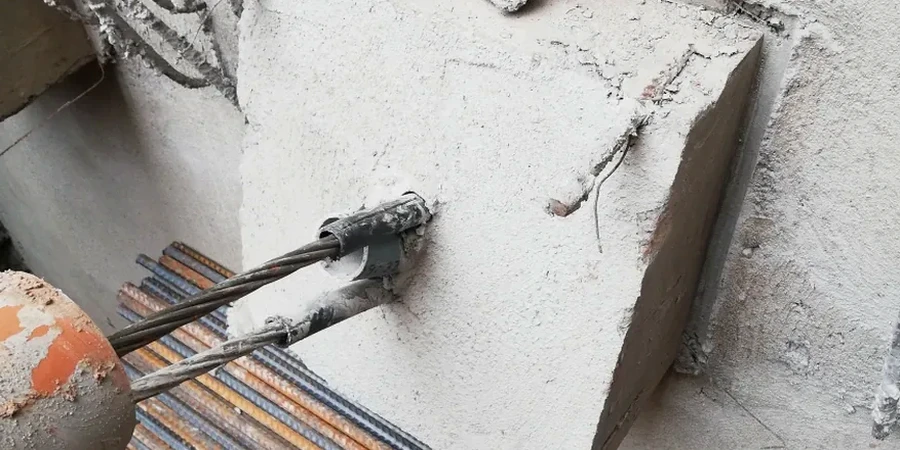
Critical ground factors in Fayetteville Arkansas
A five-story mixed-use building was going up just east of the Fayetteville Square, with a two-level basement cut that came within eight feet of a century-old masonry structure. The geotechnical investigation showed the Boone limestone dipping sharply across the site, creating a wedge of soft residual clay on the southeast corner. Without a carefully tuned anchor system, the lateral deflection could have cracked the adjacent building's limestone foundation blocks. The design team opted for an active double-corrosion-barrier tieback system at the upper two levels, locked off at 110% of the design load after proof testing, while the lower level used passive fully-grouted bars socketed a minimum of fifteen feet into rock with RQD above 70%. Monitoring during excavation showed wall movements under a quarter inch, well within the performance criteria established before construction. That kind of outcome depends entirely on anchoring into geology you understand—not just a textbook bond strength.
Our services
Anchor design in Fayetteville spans several distinct applications, from temporary excavation support to permanent slope stabilization in the area's steep residential subdivisions. Each project receives a tailored approach based on the specific geological conditions encountered.
Tieback anchor design for urban excavations
Active multistrand or threadbar anchors for basement and utility excavations near existing structures in downtown Fayetteville, with staged lock-off procedures and long-term monitoring plans.
Rock bolt and passive anchor systems
Fully grouted passive anchors for cut slopes along I-49 and Highway 16 corridors, designed to reinforce the jointed Boone limestone and prevent wedge failures triggered by freeze-thaw cycles.
Anchor load testing and performance verification
Proof tests, performance tests, and extended creep tests conducted on-site, with lift-off verification after lock-off to confirm that the anchor force meets the design specification.
Common questions
What is the difference between active and passive ground anchors, and when is each used in Fayetteville projects?
Active anchors are tensioned against the structure after installation, applying a pre-compressive force to the retained soil or rock mass. They are the standard choice when controlling wall deflection is critical—for example, when excavating next to an existing building in downtown Fayetteville where even half an inch of movement could cause damage. Passive anchors are not tensioned after installation; they develop resistance only as the ground deforms and loads the anchor. These work well in rock cuts along highways or for slope stabilization where small movements are acceptable. The choice between active and passive depends on the allowable deformation criteria and the stiffness of the retained material.
How much does an active/passive anchor design typically cost for a project in northwest Arkansas?
For a typical Fayetteville project, anchor design fees range from around US$900 for a straightforward slope stabilization with a single row of passive rock bolts, up to approximately US$3,720 for a complex multi-level tieback system on an urban excavation requiring finite element analysis, corrosion protection detailing, and construction-phase testing supervision. The final cost reflects the number of anchor rows, the complexity of the geology, and the level of performance testing specified.
Do anchors in the Fayetteville limestone require special corrosion protection?
Yes, they often do. The residual clays derived from the Hale and Fayetteville Formations tend to be acidic, with pH values that can drop below 5.5 in some locations. Combined with the high seasonal rainfall—Fayetteville receives about 47 inches per year—the environment is aggressive for steel. For permanent anchors, we specify Class I double-corrosion-barrier protection per PTI DC35.1, which includes corrugated plastic sheathing over the tendon bond length and a separate encapsulation over the free length, all sealed with controlled grout injection.