Specifying a constant coefficient of permeability for the layered residuum and shale of Washington County is a mistake we see repeatedly in geotechnical reports across Fayetteville. The weathered Boone Formation overlies the Hale sandstone in a sequence that simply does not drain uniformly. A single lab permeameter value from a remolded sample tells you nothing about fracture flow paths or the hydraulic anisotropy present in the local Springfield Plateau bedrock. Our team runs in-situ Lefranc and Lugeon packer tests because the IBC Chapter 18 requires site-specific infiltration data when designing detention basins, deep foundations, or cut slopes within city limits. Before committing to a drainage design, most engineers in Fayetteville pair these field results with a CPT test to map continuous stratigraphy, particularly where paleokarst voids are suspected.
A falling-head Lefranc test in Fayetteville residuum typically yields values of 10⁻⁵ to 10⁻⁷ cm/s, while Lugeon values in Boone limestone can jump three orders of magnitude when a fracture is intersected.
Scope of work in Fayetteville Arkansas
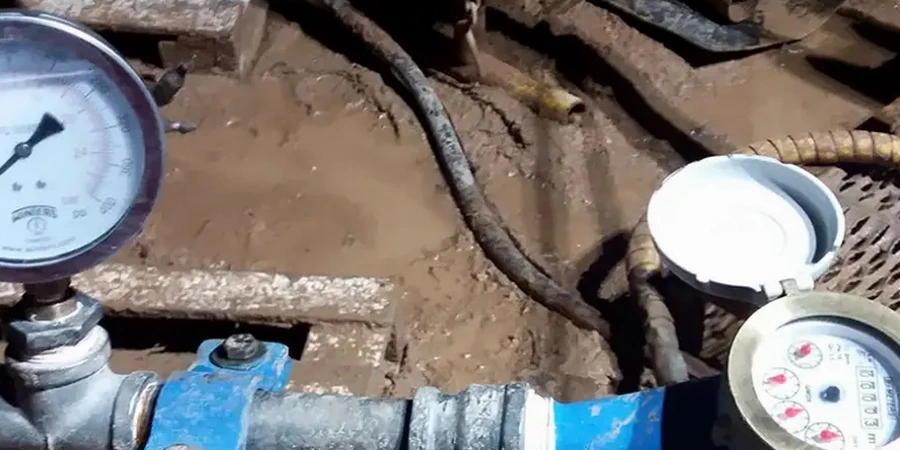
Critical ground factors in Fayetteville Arkansas
The transition from the dry summer months to the intense spring storm season in Northwest Arkansas creates a testing window that many contractors underestimate. In Fayetteville, the residual clay above the Boone Formation can saturate rapidly during April and May, causing borehole collapse before the packer is set. If testing is rushed during a wet period without proper casing advancement, the resulting Lugeon values will reflect a washed-out borehole wall rather than the intact rock mass permeability. The risk is designing a permanent dewatering system based on artificially high conductivity values. A slope stability analysis that relies on overestimated drainage capacity can fail within the first heavy rain event, particularly along the steeper cuts of the Razorback Greenway expansion areas.
Our services
We perform two distinct field permeability methods tailored to the subsurface conditions of Fayetteville, supported by ISO 17025-accredited laboratory verification.
Lugeon Packer Test
Multi-stage pressure testing in fractured Boone Formation limestone and Hale sandstone. We isolate a 1.5 m to 3.0 m zone with a pneumatic packer and apply five incremental pressures (Houlsby method) to calculate the Lugeon value and characterize fracture flow.
Lefranc Variable-Head Test
Falling-head and constant-head permeability measurement in soil and weathered residuum. The test uses a slotted PVC screen installed below the water table or in an uncased borehole section, recording flow rates at stabilized heads per ASTM D5092.
Permeability Correlation and Profiling
Integration of Lefranc/Lugeon data with grain size distributions from SPT drilling and Atterberg limits to generate a continuous hydraulic conductivity profile. We calibrate field values against lab permeameter tests for a defensible geotechnical model.
Common questions
When is a Lugeon test required instead of a standard infiltration test in Fayetteville?
A Lugeon test is specified when the foundation or excavation intercepts fractured rock of the Boone Formation or Hale sandstone. The City of Fayetteville drainage criteria manual requires packer testing for any detention basin or deep foundation where the design water table is within 5 feet of a fractured rock mass. The Houlsby multi-stage procedure quantifies fracture flow through the rock matrix, which a standard percolation test cannot measure.
How long does a typical Lefranc falling-head test take in the local residuum?
In the low-permeability clayey residuum common across Fayetteville, a single falling-head Lefranc test at a 10-foot depth typically requires 45 to 90 minutes to reach a stabilized flow condition. If the soil is unsaturated or contains chert fragments from the Boone Formation, the stabilization time can extend to 2 hours. We always run a minimum of two repetitions per test interval to verify repeatability.
What is the typical cost range for a Lefranc/Lugeon testing program in Northwest Arkansas?
How do you ensure the borehole seal is effective during a Lugeon test?
The pneumatic packer is inflated to a pressure at least 200 kPa above the maximum test pressure to guarantee a positive seal against the borehole wall. We verify the seal by pressurizing the isolated interval and monitoring for pressure decay before starting the injection cycle. In highly fractured Boone limestone, a double-packer assembly is used to test a sealed interval away from the borehole bottom, eliminating end-effect leakage.