For any project involving significant structural loads or excavations in the complex residual soils of the Ozark Plateau, the triaxial test becomes the definitive method for obtaining reliable shear strength parameters. The weathered shale and limestone formations underlying much of Fayetteville, combined with the city's steady growth that pushes development onto challenging terrain, demand a level of soil analysis that goes well beyond basic index testing. Our laboratory follows ASTM D2850 for unconsolidated-undrained conditions and ASTM D4767 for consolidated-undrained tests with pore pressure measurement, providing the effective stress parameters that geotechnical engineers need for accurate bearing capacity calculations, slope stability modeling, and retaining wall design. When site conditions near the Illinois River watershed or the steeper slopes around Mount Sequoyah introduce layered stratigraphy, complementing the triaxial program with a CPT investigation can map the vertical variability before selecting the critical specimens for advanced strength testing.
Effective stress parameters from a consolidated-undrained triaxial test provide the only reliable input for modeling the long-term stability of excavations in the overconsolidated clays of the Ozark region.
Scope of work in Fayetteville Arkansas
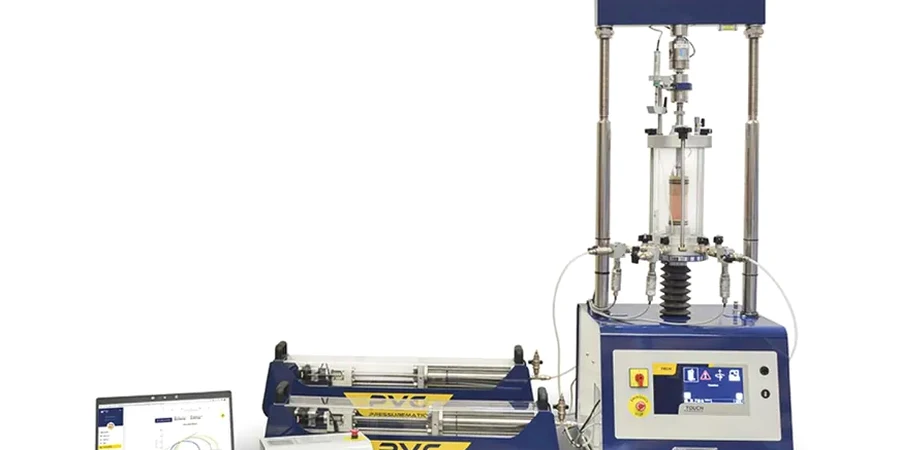
Critical ground factors in Fayetteville Arkansas
The seasonal rainfall pattern in Northwest Arkansas, with intense spring storms delivering over 45 inches of precipitation annually, creates a geotechnical environment where pore pressure response governs the stability of any earthwork or foundation. A structure designed solely on total stress parameters from quick undrained tests may perform adequately in the dry summer months, but the same soil mass can lose significant strength as saturation fronts advance through the fissures typical of the Fayetteville Shale. The triaxial test under consolidated-undrained conditions with pore pressure measurement captures this behavior explicitly, generating effective stress envelopes that account for the reduction in normal stress across potential failure surfaces as pore water pressures rise. Ignoring the stress history of the overconsolidated clays—which have been unloaded by erosion of hundreds of feet of overburden over geologic time—can lead to excavation heave and progressive failure that manifests months after construction, a scenario observed in several deep cuts along the Highway 112 widening corridor. The test data directly feeds into limit equilibrium slope models and finite element simulations that assess the factor of safety against such time-dependent failures.
Our services
The triaxial testing program can be configured to match the specific stress path and drainage conditions that a Fayetteville project demands, from rapid loading on foundation subgrades to the long-term drained response of cut slopes.
Unconsolidated-Undrained (UU) Triaxial
Quick test providing total stress parameters (cu, φu) for short-term bearing capacity analysis on fine-grained soils, following ASTM D2850 with strain-controlled loading at 1% per minute.
Consolidated-Undrained (CU) with Pore Pressure
Defines effective stress strength envelope (c', φ') by measuring pore pressure during shear; essential for slope stability modeling and embankment design on the Fayetteville Shale.
Consolidated-Drained (CD) Triaxial
Long-duration test for determining drained strength parameters of granular materials or for analyzing the long-term condition of permanent earthworks, per ASTM D7181.
Multi-Stage Triaxial Testing
Applies successive confining stages on a single specimen, maximizing data from limited Shelby tube samples recovered from deeper strata in the Ozark limestone and shale formations.
Common questions
What is the approximate cost of a triaxial test program for a Fayetteville project?
A single triaxial test, depending on whether it is UU, CU, or CD, typically falls in the range of US$1,800 to US$2,660 per specimen. A complete program with three confining pressures to define a failure envelope will scale accordingly. The final cost depends on specimen preparation time, saturation requirements, and the strain rate dictated by soil permeability.
When is a CU triaxial test required instead of a simpler unconfined compression test?
A consolidated-undrained triaxial test is required when the design must account for pore water pressure development during loading, which is the case for any slope stability analysis, embankment on soft ground, or excavation in saturated clay. The unconfined compression test cannot measure pore pressure and provides only a crude undrained strength value that may be unconservative for the slickensided Fayetteville Shale.
How long does it take to get triaxial test results back from the lab?
The timeline varies by test type. UU triaxial tests can be reported within 3 to 5 business days after sample extrusion. A CU test with pore pressure measurement requires saturation, consolidation, and a slow shear phase that can extend the turnaround to 2 to 3 weeks, especially for low-permeability clays that need slow strain rates to allow pore pressure equalization.
What soil types in Fayetteville benefit most from triaxial testing?
The residual clays derived from the weathering of the Fayetteville Shale and the limestone formations of the Boone Group benefit most from triaxial testing. These materials often exhibit overconsolidation, fissures, and slickensides that produce strength parameters which cannot be reliably estimated from SPT blow counts or simple index tests alone.