Fayetteville's transformation from a small college town into a vibrant regional hub has pushed construction into tighter urban lots and steeper terrain. The city sits on the Springfield Plateau, where the Boone Formation limestone meets residual clays with chert fragments—a profile that demands precise excavation support design. A deep excavation project near Dickson Street, for instance, often encounters weathered rock at just 8 to 12 feet below grade, transitioning abruptly to competent limestone. This variability, combined with a population approaching 100,000 and ongoing campus expansion, means that standardized shoring designs rarely work here. Our geotechnical group develops site-specific solutions for excavations exceeding 15 feet, integrating in-situ permeability tests when groundwater control becomes critical to the overall stability of the cut.
In Fayetteville's Springfield Plateau geology, the difference between weathered chert and competent limestone can shift by several feet within a single building footprint, requiring continuous geotechnical verification during excavation.
Scope of work in Fayetteville Arkansas
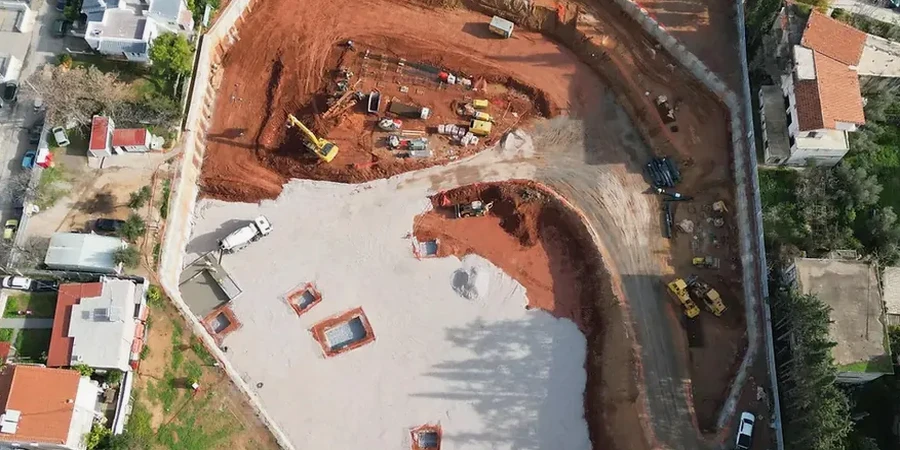
Critical ground factors in Fayetteville Arkansas
A recent excavation for a five-level mixed-use building on College Avenue exposed a weathered chert seam running diagonally through the site at 20 feet deep, which had not been fully mapped during preliminary borings. The overbreak into the seam created a cavity behind the soldier pile wall, causing localized settlement in the adjacent sidewalk within 48 hours. This scenario highlights the dominant risk in Fayetteville deep excavations: the unpredictable karst-like voids and differential weathering pockets within the Boone Formation. Without a solid instrumentation plan—including inclinometers behind the wall and optical survey points on neighboring foundations—such movements can escalate into third-party claims. We require inspection of every rock lift by a geotechnical engineer before shotcrete or lagging is applied, ensuring that soft seams are cleaned out and backfilled with lean concrete to restore passive resistance.
Our services
Our excavation support designs for Fayetteville projects incorporate both temporary and permanent facing systems, tailored to the local limestone and residual clay profile. Each design includes a detailed constructability review and a ground movement prediction report.
Tieback Anchor Design in Karstic Limestone
We design high-capacity tieback anchors with bond zones in competent limestone below weathered karst features. Our process includes water pressure testing in each anchor hole to verify grout confinement and performing sacrificial anchor pullout tests to validate ultimate bond stress assumptions before production drilling begins.
Soil Nailing and Hybrid Shoring Systems
For cuts through residual clay overburden where rock is deeper than 15 feet, we develop soil nail walls with permanent facing. When pinnacled bedrock is encountered mid-face, we transition to a hybrid system combining soil nails in the upper overburden with rock dowels in the lower limestone, ensuring a continuous load path across the variable interface.
Common questions
What is the typical cost range for geotechnical design of a deep excavation in Fayetteville?
For most commercial and mixed-use projects in Fayetteville with excavation depths between 15 and 35 feet, the geotechnical design fee typically ranges from US$2,280 to US$7,950. The final cost depends on the complexity of the subsurface profile, the number of shoring wall design sections, and whether rock mechanics analysis is required for tieback anchors in the Boone Formation.
How do you address groundwater control during deep excavation in Fayetteville's limestone?
We evaluate the perched water table within the weathered chert and limestone interface through packer tests and observation wells installed during the exploration phase. Where inflows exceed manageable seepage, we specify a system of horizontal drains drilled through the soldier pile wall or a deep well dewatering system with pumps sized for the hydraulic conductivity of the fractured rock mass.
Can a deep excavation be safely executed next to historic masonry buildings in downtown Fayetteville?
Yes. We establish vibration limits based on the condition assessment of the adjacent historic structure, typically limiting peak particle velocity to 0.5 in/s for unreinforced masonry. The support system is designed to limit lateral wall deflection to less than 0.3% of the excavation height, and we monitor movement with automated total stations and crack gauges throughout the entire excavation and dewatering process.
What seismic earth pressures do you apply for deep excavation design in Fayetteville?
We use the Mononobe-Okabe method with peak ground acceleration values from the USGS seismic hazard maps for the Springfield Plateau. For Fayetteville, the mapped Ss and S1 values per ASCE 7-22 are applied to calculate seismic active earth pressure coefficients, considering the dynamic amplification of the retained soil mass and the potential reduction in passive resistance during a seismic event.